
Edison Dengler
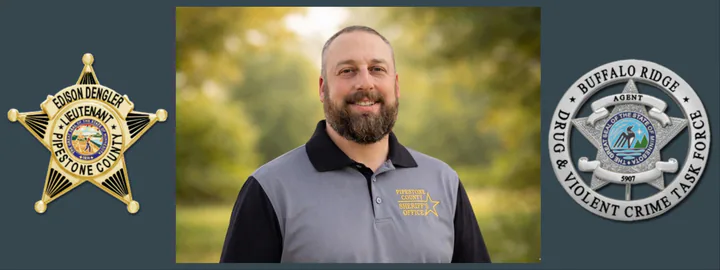
- Office
- County Sheriff, Pipestone County
- State
- Minnesota
- Status
- On the general ballot
- Election
- Election held Nov 3, 2026
- Result
- Counting
Build a campaign strategy for Edison Dengler
About Edison Dengler
Experience
- Tracy Police Department, Officer
- Pipestone County Sheriff’s Office, Lieutenant
Where Dengler stands
Campaign site, updated Nov 1, 2026. The campaign's issues page
Criminal Justice, Firearms & Corrections
Criminal Justice, Firearms & Corrections
Question Asked = How will you keep rural communities safe?
Answer = Keeping our rural communities safe starts with visibility, communication, and proactive law enforcement. Pipestone County is made up of small towns, farms, rural homes, schools, businesses, county roads, and th…
Answer = Keeping our rural communities safe starts with visibility, communication, and proactive law enforcement. Pipestone County is made up of small towns, farms, rural homes, schools, businesses, county roads, and three major highways. Every citizen deserves to feel protected, no matter where they live.
As Sheriff, I will maintain a strong patrol presence throughout the county; not just in one area. That means ensuring deputies are visible in our small communities, on rural roads, around schools, and in areas where citizens have shared concerns. Law enforcement cannot be everywhere at once, but we can be intentional, proactive, and responsive.
I will also continue building strong relationships with city leaders, townships, fire departments, EMS, schools, farmers, business owners, and residents. Rural public safety depends on communication and trust. When people feel comfortable reporting suspicious activity, asking questions, or bringing concerns forward, we are better able to prevent problems before they become larger issues.
Too often, I hear that someone did not report suspicious activity or a crime because they believed no one would care since it happened in a rural area. People need to know that the Sheriff’s Office will investigate an incident occurring in the most rural or remote part of the county with the same level of commitment as we would if it happened in downtown Pipestone.
Drug activity, theft, scams, violent crimes, and property crime calls all affect rural communities. My experience with the Buffalo Ridge Drug and Violent Crime Task Force has shown me that these issues do not stop at city limits, county lines, or state lines. I will continue supporting regional partnerships, information sharing, and proactive investigations to protect every part of Pipestone County.
Keeping rural communities safe also means being prepared. I will continue promoting investigative training for deputies, the responsible use of technology, and coordination with neighboring agencies when additional resources are needed.
My goal is to lead a Sheriff’s Office that is visible, accessible, prepared, and fully committed to protecting the people, property, and way of life that make rural Pipestone County home.
Agriculture, Food & Animals
How would you work toward animal control and humane treatment solutions in Pipestone County?
Question = It’s no secret that Pipestone county has had a long standing issue of lack of or flat out absence of any humane animal control other than for dogs.
Question = It’s no secret that Pipestone county has had a long standing issue of lack of or flat out absence of any humane animal control other than for dogs.
With no animal shelter or animal control officers in rural areas the responsibility of enforcing and or aiding humane treatment up to and including all domestic animals and injured and orphaned wildlife falls on local police departments and their limited resources.
What is the best way to help in animal abuse situations in Pipestone County.
Question Asked - What is the best way to help in animal abuse situations in Pipestone County. From horses, cattle, cats and dogs, etc. There seems to be little training for our officers and little to no experience in th…
Question Asked - What is the best way to help in animal abuse situations in Pipestone County. From horses, cattle, cats and dogs, etc. There seems to be little training for our officers and little to no experience in these situations. What’s the first thing we can do to help in these situations and how do we know something was even done to help the animals? A lot of times we witnessed that nothing changes after the officer investigates. How do we change this? How do we help the animals and help those who call in with concerns? Thank you.
Answer - First, thank you for reaching out with your question about animal calls!
Animal neglect and abuse cases can be tough, especially in a rural county with no local animal shelter or full-time animal control officer. I can assure you that if someone reports a concern, it will be looked into, documented, and followed up on when needed.
We actually deal with a lot of animal calls throughout the county. Deputies respond to all of these calls, and we require reports to be written for every call they handle. Those reports are also required to be approved by a supervisor before they are closed out.
The first thing people can do to help is report the concern to our office and provide as much detail as possible, including where the animals are, what you saw, how long it has been going on, dates and times, the number and type of animals involved, and photos or video if it can be done safely and legally
Too many times we see posts on social media about alleged animal neglect and a lack of law enforcement response, when in reality it was never reported to law enforcement. We cannot respond to calls we do not know about so we encourage the public to make reports to our office.
If you make a complaint and provide your contact information, you can ask that a deputy let you know the outcome of the investigation, and I will make sure you receive a call back. If the complaint is made anonymously, we may not be able to contact that person with follow-up questions or let them know what was done. Anonymous reports are still important, but having a name and contact information can really help if more details are needed. That does not mean your name is automatically shared with the person being reported, but it does give deputies a way to follow up and build a stronger case if needed.
If you make a report and a deputy responds, but you do not notice any changes in the following days, please call back and make another report. Sometimes when we get to a call, we may not have enough evidence to take action at that time. For example, the person may have brought the animal inside before the deputy arrived. If you call back with follow-up concerns, your next complaint may provide that one more piece of the puzzle needed to build a case. Please never think, “I’m not going to report it because nothing will be done.”
If a person makes an animal neglect report and does not see a deputy respond immediately, it is quite possible there was another call that took priority, such as a domestic, medical, or vehicle crash. But rest assured, someone will respond once a deputy is available. All of our calls are computerized, logged by time, and cannot be cleared unless a report has been added and that report approved by a supervisor.
Future discussions may also need to take place with the city related to animal control, and I am more than willing to bring these concerns to the appropriate officials.
Thank you again for reaching out!
If you are elected sheriff how would you work towards solutions to uphold these laws and provide these services to Pipestone County residents?I
Answer = Thank you for the question. Animal control in a rural county can be difficult, especially when there are no local animal shelters and limited dedicated animal control resources.
Answer = Thank you for the question. Animal control in a rural county can be difficult, especially when there are no local animal shelters and limited dedicated animal control resources.
My first two years working for a law enforcement agency were spent working as a Community Service Officer for the City of Willmar. During that time, I worked as an Animal Control Officer, where I attended training and received certifications in animal control; because of this, I am very familiar with this area of enforcement and the challenges that come with it. I also had a narcotics detection K9 partner for 10 years and consider myself an animal lover.
Having worked for the Pipestone County Sheriff’s Office (PCSO) since 2006, I can say the PCSO responds to and investigates all animal complaints when laws are being violated. This includes animal neglect, cruelty, public safety concerns, or injured animals creating a hazard. PCSO regularly responds to calls involving animals left outside in extreme weather, animals left in vehicles, stray dogs, injured animals, and other animal related concerns. In fact, it is not all that uncommon to see a dog walking around our squad room or dispatch area while we try to locate an owner before getting the animal to a kennel, or while we are caring for someone’s pet after they were involved in a crash and had to seek medical attention.
At one time, there was a nonprofit in Pipestone County that would take in stray cats, but to the best of my knowledge, that organization no longer exists. Consequently, there are currently no local options available for stray or feral cats in Pipestone County. This being said, we do have options available when it comes to animal abuse or neglect, which we do deal with from time to time.
With respect, I would consider the comment that “PCSO has a long-standing issue of lack of or flat-out absence of any humane animal control other than for dogs” to be misinformation and inaccurate. We deal with a wide range of animal calls. Over the years, I can think of many occasions where our office has responded and provided care for many species of animals from reptiles, birds, horses, and cattle, to cats and other wildlife.
We have had situations where we set up temporary reptile habitats in our conference room when people were going through difficult circumstances and needed someone to care for their reptiles while arranging for family or friends from out of state to come pick them up. We once had a deputy, who is not fond of snakes, pick up a large abandoned boa from the roadway and help care for it until it could be turned over to someone qualified to rehome it. I remember taking neglected turtles out of an aquarium that was so dirty you couldn't see them swimming in the water, and turning them over to the Department of Natural Resources (DNR) for care. I once found a wild raccoon that someone was trying to make a pet locked in a bedroom of a house, and we cared for it until the DNR could take custody. Deputies have picked up injured animals and rushed them to local veterinarians for emergency care. We have worked cases involving neglected cattle and horses that needed to be fed, watered, and rehomed. As Sheriff, I will continue to make sure those calls are taken seriously and handled professionally.
For injured or orphaned wildlife, I would continue to rely on the proper resources, specifically the Minnesota DNR conservation officers, who are responsible for incidents involving wildlife. Our office will continue to work with the DNR and licensed wildlife rehabilitators when dealing with injured wildlife, as we are often the first ones to respond to these calls. I understand these calls can be emotional and difficult, but they must be handled safely, legally, and appropriately.
At the same time, we need to be honest about what the Sheriff’s Office can and cannot do on its own. Deputies are not veterinarians, wildlife rehabilitators, or animal shelter staff. If you look at larger neighboring communities, animal control units are often operated by municipalities using civilian staff to handle non-criminal city ordinance enforcement as well as animal control. Those units often work with local shelters to house stray animals, and unfortunately, Pipestone County has no animal shelters and no cities have animal control officers.
As Sheriff, I would be open to practical discussions about solutions by bringing the right people to the table. That includes the County Board, city leaders, veterinarians, rescue groups, conservation officers, and community volunteers with the goal to identify what resources currently exist, where the gaps are, and what realistic options are available for Pipestone County.
My approach would be simple: enforce the laws we are responsible for enforcing, treat animal-related calls with professionalism and compassion, and work with partners to build a realistic and humane system for Pipestone County residents.
This issue will not be solved by one person or one office alone. But as Sheriff, I am willing to help lead that conversation and work toward solutions that are lawful, practical, compassionate, and fiscally responsible.
Mental health & youth crisis
Health & Human Services
How will you handle mental health crisis calls?
Question asked:
Question asked:
How will you handle mental health crisis calls? How will you make sure deputies are trained for these situations? You say you are fiscally responsible, so how will you pay for all this additional training? Do you think it is appropriate to hold people in jail? Why don’t I see your training records online?
Answer:
First, thank you for the question. You asked several important questions, and I will do my best to answer each of them.
Mental health crisis calls are some of the most difficult and high-stress situations law enforcement responds to. They require patience, communication, de-escalation, and the ability to slow things down whenever it is safe and practical to do so. Law enforcement is only one piece of the mental health response, but deputies are often the first ones on scene.
As Sheriff, my priorities will be to protect everyone involved, reduce the need for force whenever possible, and work to connect people with the care they actually need.
A person experiencing a mental health crisis does not automatically belong in jail. A mental health crisis is a medical crisis, not a crime. If someone has not committed a criminal offense, they should not be sitting in a jail cell.
When a call involves a medical or mental health crisis, our practice has always been, and will continue to be, working alongside EMS and medical providers to get that person safely transported to an emergency room or appropriate medical facility for evaluation and treatment. Jail should not be used as a substitute for mental health care. It is not effective, it is not appropriate, and it places the burden on the wrong system.
Training is a major part of handling these calls the right way. Deputies need the tools to recognize warning signs, communicate effectively, de-escalate when possible, and make sound decisions quickly under pressure. Minnesota POST already requires mental health training as part of every peace officer license renewal cycle, and we will continue to meet and build on those requirements.
The Minnesota Sheriffs’ Association offers Crisis Intervention Team, or CIT, certification to deputies across the state. This provides more advanced instruction for responding to people in crisis. Sheriff Vreeman made that training available to our staff, and I, along with some other deputies, took the initiative to complete this optional advanced training. As Sheriff, I will continue working to get our remaining deputies and newly hired staff through that training as well.
We can do this while still being fiscally responsible. Being fiscally responsible does not mean ignoring training needs. It means using the resources we already have, seeking out cost effective options, and partnering with others whenever possible. We can use training already provided through the POST Board, the Minnesota Sheriffs Association, and PATROL Online. We can also host or attend regional training with neighboring agencies to share costs and bring quality instruction to southwest Minnesota.
The bigger issue is that law enforcement cannot fix the mental health system by itself. Rural counties face a real shortage of mental health resources, treatment options, and available treatment beds. Too often, EMS and law enforcement are left trying to solve a problem that requires medical care, family services, and state level support.
As Sheriff, I will continue working with Southwest Health and Human Services, EMS, local schools, medical providers, neighboring agencies, and state lawmakers to advocate for better mental health resources in rural Minnesota.
Improving crisis response will take more than law enforcement alone. I believe one of the most important things we can do is continue serious discussions with lawmakers who have the ability to appropriate funding for crisis response, treatment options, and rural mental health resources.
Right now, medical facilities are limited, and family services continue to face funding challenges, with their abilities often stretched thin. In more severe cases, the courts rely on these teams to conduct timely reviews before hearings can even be held in front of a judge.
Minnesota also has a serious shortage of treatment facilities. It is not uncommon to hear of EMS transporting individuals as far as Fargo or Rochester simply because there are no local treatment options available. That is not sustainable for EMS, families, or the individuals in crisis.
I have already been part of discussions with other chiefs and sheriffs from southwest Minnesota who share these same concerns. As Sheriff, I will continue those discussions with lawmakers and other appropriate individuals to make sure the frustrations and needs of rural communities like Pipestone County are heard. We need better resources, better treatment access, and a system that does not leave law enforcement, EMS, and families trying to fill the gaps alone.
People in crisis deserve to be treated with dignity. Deputies deserve the training and support to handle these calls safely. The public deserves a Sheriff’s Office that responds with professionalism, compassion, and accountability, while keeping public safety the top priority.
As far as my training records, I assume you are looking at the public peace officer search through the Minnesota POST Board at https://mnitservices.my.site.com/POSTLicenseSearch/s/ Due to my assignment on a task force and Minnesota statute, my records are not listed on that site. However, I do have a link on my website showing my training from the last 10 years:
www.denglerforsheriff.org/training-new
Thank you for your questions.
Police funding & accountability
Police funding & accountability
Public Safety & Emergency Services
Question asked
With the rise in autism and the number of nonverbal individuals, how do you plan to help these individuals? Are deputies receiving training to communicate effectively with them?
Answer
First, thank you for the question. Over the past several years, the Minnesota POST Board, the Minnesota Sheriff's Association, and the Minnesota Chiefs of Police Association have all made big efforts to provide training…
First, thank you for the question. Over the past several years, the Minnesota POST Board, the Minnesota Sheriff's Association, and the Minnesota Chiefs of Police Association have all made big efforts to provide training and guidance related to autism and the many ways ASD can affect communication and behavior.
As a requirement to renew our peace officer licenses, every officer must complete at least four hours of autism specific training during each licensing cycle. Beyond that requirement, there are approximately 90 hours of POST approved optional training focused specifically on autism. Sheriff Vreeman has also made several of these optional training opportunities available to our staff through these organizations.
One course Sheriff Vreeman made available to staff through the Minnesota Sheriff’s Association is the 24 hour Crisis Intervention Team course. This training covers mental health conditions, crisis recognition, de-escalation techniques, and effective communication strategies. I, along with some other members of our office, have completed this optional training and found it extremely valuable. One module is dedicated specifically to autism and focuses on recognizing the many unique characteristics of ASD and teaching communication techniques tailored to these individuals.
As Sheriff, I would continue to provide these training opportunities to staff and strongly encourage those who have not completed the CIT course to do so.
While training is essential, every individual is different. My goal as Sheriff would be to ensure our deputies are provided with the training and tools needed to safely and effectively perform their duties. When communicating with individuals with ASD or those who are nonverbal, deputies will make every effort to communicate in a way that best meets that specific individual’s needs. This may involve utilizing the help of caregivers, family members, friends, doctors, or anyone else who may be able and willing to help ensure the safest outcome.
As Sheriff, I will work to make sure our deputies are equipped to provide safe, compassionate, and professional service to every member of our great community.
State Budget, Bonds & Finance
What is your experience with budgeting, staffing, contracts, and daily Sheriff’s Office operations?
Question asked - What is your experience with budgeting, staffing, contracts, and daily Sheriff’s Office operations?
Question asked - What is your experience with budgeting, staffing, contracts, and daily Sheriff’s Office operations?
Answered - I have extensive experience with budgeting, staffing, contract negotiations, personnel management, purchasing, and the daily operations of the Pipestone County Sheriff’s Office.
I have helped lead the research, testing, selection, and purchase of squad-camera systems on two separate occasions, as well as the Sheriff’s Office’s recent implementation of body-worn cameras. Projects of this size require careful planning, detailed vendor comparisons, contract negotiations, and strict attention to an established budget.
Chief Deputy Hamann and I negotiated multiple contract provisions with the selected vendor to ensure the project remained under budget and provided the best long-term value for taxpayers. The final agreement included terms the vendor described as unlike any contract it had previously signed and is expected to save Pipestone County taxpayers thousands of dollars over the next 10 years.
Over the past seven years, I have worked directly with dealerships to solicit competitive bids for squad vehicles and have presented those bids to the County Board for approval. This purchasing process was audited by the State of Minnesota with no issues or recommendations. That outcome demonstrates the importance of maintaining an organized, transparent, and fiscally responsible purchasing process.
I have also worked with the Sheriff and County Board to obtain competitive bids for the purchase of three K9s, along with the training and equipment needed for each K9 team. These projects required careful planning and coordination to ensure the dogs, training, and equipment were obtained within the established budgets while still meeting the operational needs of the Sheriff’s Office.
I have directly participated in negotiating multiple labor contracts with Pipestone County. This experience has given me a strong understanding of wages, benefits, staffing needs, employee relations, county policies, and the importance of reaching agreements that are fair to employees and financially responsible for taxpayers.
Since 2015, I have also been actively involved in hiring deputies, correctional officers, dispatchers, and the jail administrator. My responsibilities have included reviewing applications, serving on oral interview panels, conducting background investigations, issuing equipment, and training. I also recommended and helped implement a formal Field Training program alongside the Chief Deputy to provide new employees with consistent, structured, and accountable training.
On a daily basis, I frequently serve as the front-line supervisor during major investigations and high-stakes incidents. In that role, I coordinate personnel, equipment, outside-agency assistance, and other resources needed to respond safely and effectively.
As Assistant Commander of the Buffalo Ridge Drug and Violent Crime Task Force, I work alongside the Commander to review and approve operational plans and ensure agents operate within the strict policies and procedures established by the Minnesota Violent Crime Coordinating Council. The task force is audited annually for compliance, making careful oversight, accurate documentation, and accountability essential.
When the Sheriff and Chief Deputy are unavailable, I may assume responsibility for Sheriff’s Office operations. All of these experiences have prepared me to manage personnel, oversee complex operations, make sound financial decisions, negotiate contracts, and ensure the Sheriff’s Office continues operating safely, professionally, efficiently, and responsibly.
To view other questions or ask a question of your own please follow the link below
Public Safety & Emergency Services
Public Safety & Emergency Services
If you become Sheriff, would you implement more community outreach
Question Asked = If you become Sheriff, would you implement more community outreach in order to build greater trust within the community? I think it would be good for the community to see that our law enforcement are ju…
Question Asked = If you become Sheriff, would you implement more community outreach in order to build greater trust within the community? I think it would be good for the community to see that our law enforcement are just regular people behind the badge.
Answer = Yes, absolutely. I couldn't agree more! Building that connection is incredibly important. Anyone who knows me knows how much I enjoy getting out there, giving community presentations, and chatting with people at local events like the county fair and the Dutch Festival.
The Sheriff’s Office shouldn’t only be visible when someone is having a tough day or needs an emergency response. People should have the chance to get to know our deputies, dispatchers, and jail staff in positive settings. At the end of the day, the people behind the badge are just regular people; we’re your neighbors, parents, spouses, youth coaches, and volunteers. That’s exactly why we encourage our deputies to attend school sport events and community events whenever they can, both on and off duty.
As Sheriff, I want to keep expanding these efforts. That means staying active in our schools, offering public safety and drug awareness education, and continuing programs like permit to carry classes, youth firearm safety, and ATV safety classes. These programs are great because they let folks ask questions, learn, and build a relationship with us long before a crisis ever happens.
Trust isn't built overnight, and it takes more than just words. It’s built on consistency, visibility, and treating people with respect. I want the Pipestone County Sheriff’s Office to be approachable and deeply connected to the people we serve, and active community outreach is exactly how we keep strengthening that bond.
Thank you for the question!
Quoted from the campaign's website. What a campaign says is weaker evidence than a bill it sponsored or a vote it cast.
Track record
In the candidate's own words
My commitment to Pipestone County is deeply personal.
My wife, Lynn, and I began our journey together as high school sweethearts. After graduating high school, myself from Murray County Central and Lynn from Pipestone Area Schools, we made the choice to build our life right here, grounded in the values of hard work, family, service, and community.
Today, Lynn and I are the proud parents of two daughters, Coral and Molly, who both attend Pipestone Area Schools. As a family, we love biking the Casey Jones Trail, hiking at the state park, camping, riding ATVs, and making memories throughout the area we are so proud to call home.
For me, Pipestone County is more than just a place on a map. It is where I work, raise my family, serve my neighbors, and invest in our shared future. That devotion to family and community is what drives my mission to ensure Pipestone County remains a safe, strong, and welcoming place for every family to thrive.
Serving this county is not just a job to me it is a responsibility. It is about protecting the communities that shape us, supporting the families who call this home, and ensuring the next generation grows up safe, secure, and proud of where they come from.
This is more than where I live. It is what I am fighting for.
Campaign site, updated Nov 1, 2026.
Attention
- News articles, last 30 days
- 0
- Ads seen, last 30 days
- 0
Updated Nov 25, 2026.
Ran against
Official site and accounts
Filing record
The candidacy record
| Status | True from | Known since |
|---|---|---|
| On the general ballot | — | Oct 14, 2026 |
Updated Oct 31, 2026.